Luxury Hotels Atlas / Places / United States / New York City / The St. Regis New York
The St. Regis New York
New York City, New York, United States · St. Regis · Grand Luxury
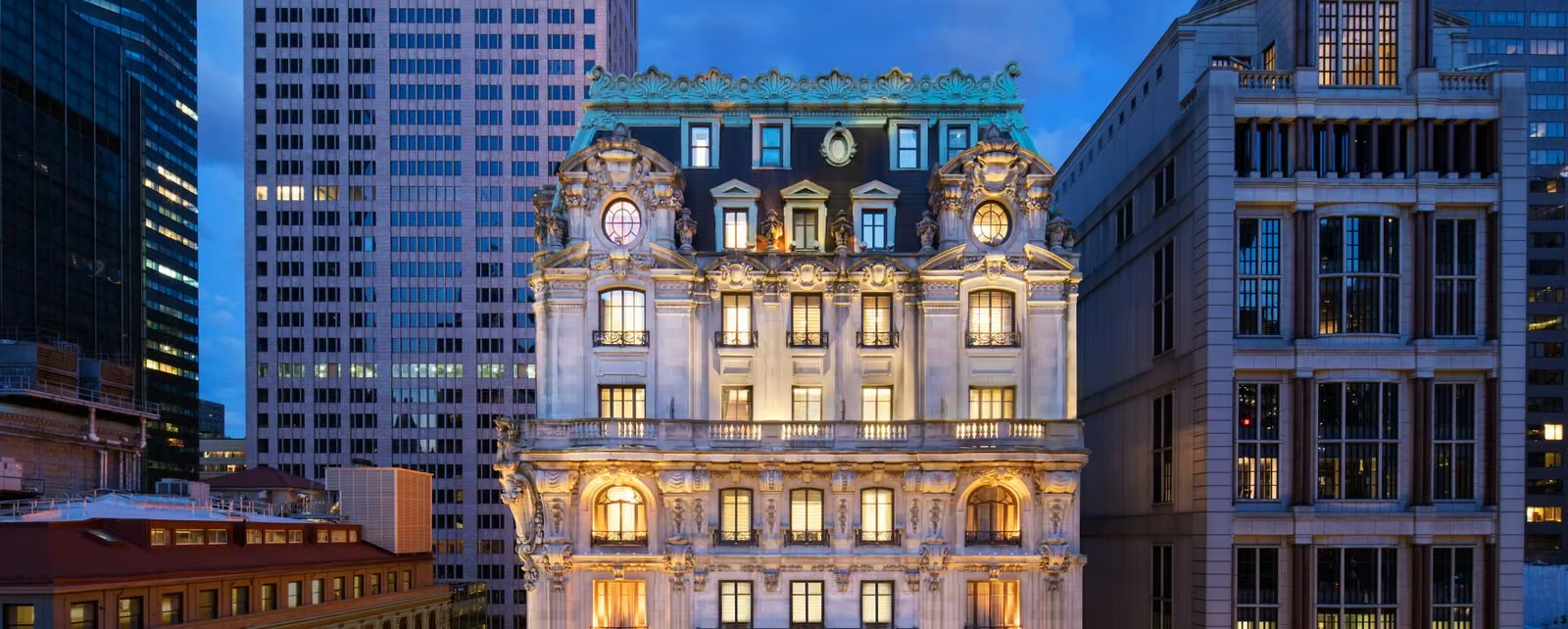
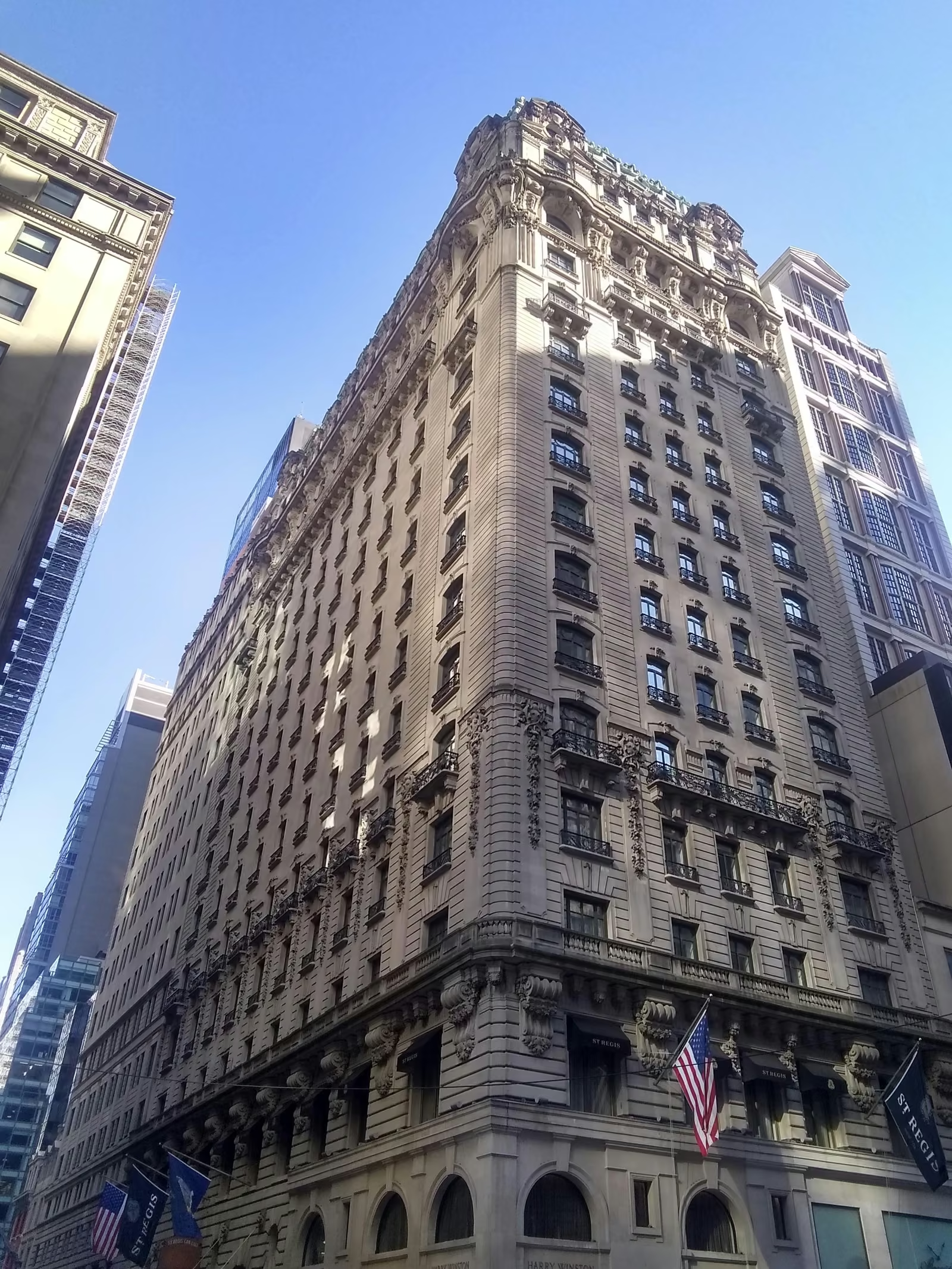
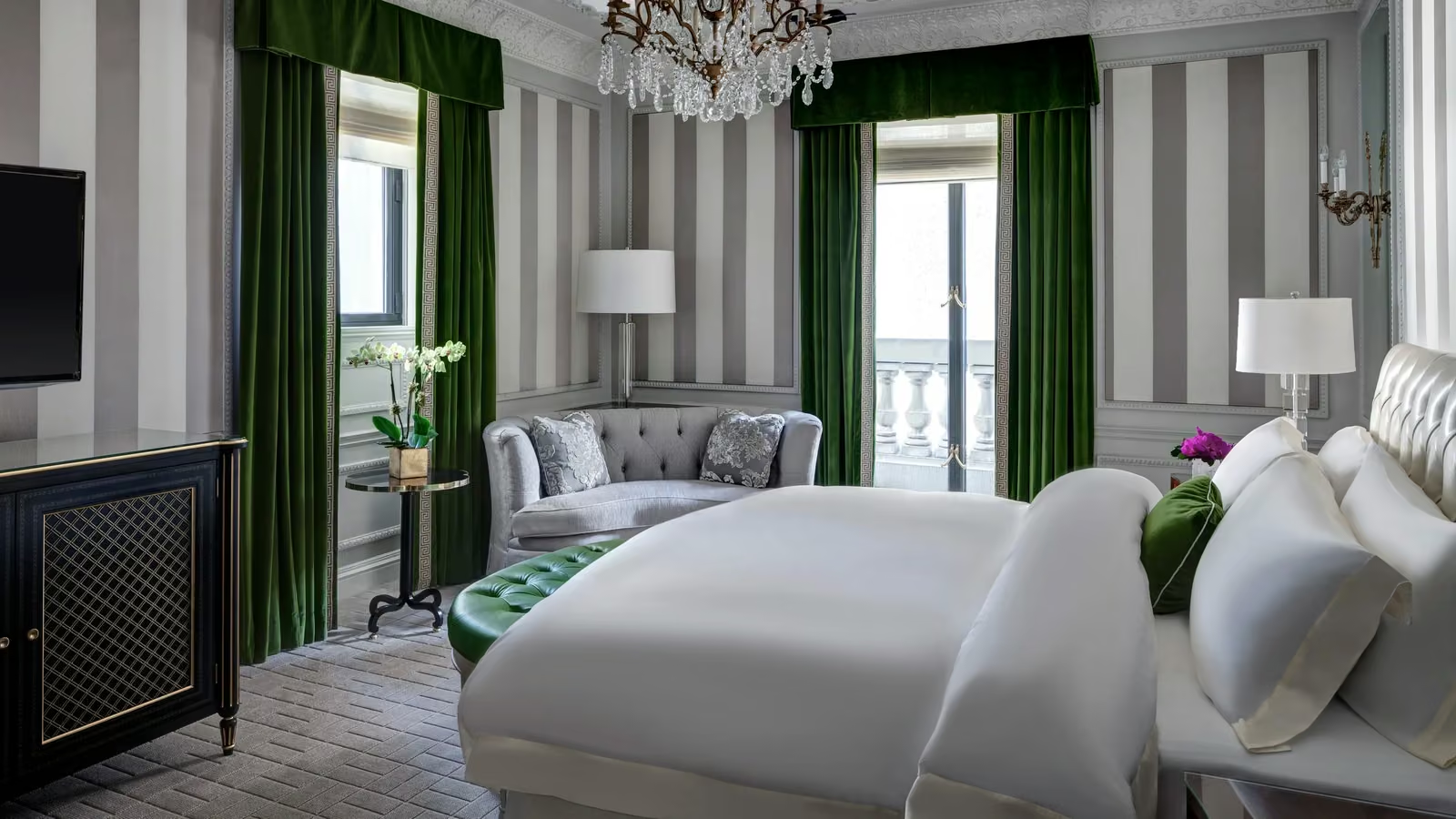
John Jacob Astor IV opened the Beaux-Arts St. Regis on 4 September 1904 as New York's tallest hotel, a $5.5 million Trowbridge & Livingston tower at Fifth and 55th. The King Cole Bar later served Fernand Petiot's Bloody Mary as the Red Snapper in 1934 beneath Maxfield Parrish's Old King Cole mural. Salvador Dalí kept rooms for years; Qatar Investment Authority bought the landmark in 2019.
- 256 rooms
- Opened 1904
- Neighborhood: Midtown
- Rooms from 450 sq ft (42 m²)
- Architect: Trowbridge and Livingston; Trowbridge & Livingston
- Interiors: Arnold Constable & Company; Stonehill Taylor
About The St. Regis New York
- Astor completed the hotel in 1904 to Trowbridge & Livingston designs; a Sloan & Robertson annex opened in 1927.
- It opened as the tallest hotel in New York and later became a New York City designated landmark with Forbes Five-Star and AAA Five Diamond ratings.
- The King Cole Bar introduced the Bloody Mary to America in 1934 under the house name Red Snapper.
- Maxfield Parrish's Old King Cole mural has defined the bar since the early twentieth century.
- Salvador Dalí kept a long residence here, sometimes with his pet ocelot; Astor himself died on the Titanic in 1912.
History
The St. Regis New York was born from the imagination of John Jacob Astor IV, the wealthiest man aboard the Titanic, who spent his fortune building what he intended to be the most perfect hotel in the world. Astor purchased the land at Fifth Avenue and 55th Street in 1898 and commissioned architect Trowbridge and Livingston to design an eighteen-story Beaux Arts palace that would stand as the tallest hotel in New York when it opened in 1904. The construction cost $5.5 million — an almost incomprehensible sum for the era — and the result justified the extravagance. The St. Regis introduced central air conditioning to New York hotels, installed its own electrical plant, and offered butler service to every guest, an Edwardian refinement that became the foundation of the brand's global identity.
Astor died in the Titanic disaster in 1912, but the hotel he built survived and flourished in ways that have made it one of the most consequential addresses in American cultural life. The King Cole Bar, which opened in the building's basement in 1906 and moved to its current location in 1932, became famous for the Maxfield Parrish mural that still covers its north wall — a painting commissioned by Astor depicting Old King Cole that Parrish originally created for the Knickerbocker Hotel before it found its permanent home at the St. Regis. In 1934 the bar's head bartender, Fernand Petiot, brought his recipe for the Bloody Mary from Paris's Harry's New York Bar and served it at the King Cole under the temporary name "The Red Snapper" at the request of hotel management, who considered "Bloody Mary" too vulgar for the room. The cocktail's American debut at the King Cole Bar is one of the most enduring origin stories in the history of American drinking.
Beneath the soaring coffered ceilings of the Astor Court, guests have been taking afternoon tea for more than a century, served beneath a Waterford crystal chandelier in a salon whose trompe-l'oeil ceiling remains among the finest decorative paintings in any American hotel. The hotel has been the address of choice for monarchs, presidents, and cultural figures across every decade of its existence: Marlene Dietrich maintained a suite here in the 1930s and 1940s; Salvador Dalí kept a residence for twenty years, sometimes accompanied by his ocelot; Marilyn Monroe, Noël Coward, and John Lennon were all guests at various points in the twentieth century.
The building underwent a major restoration in 1991 under new ownership that returned its gold and marble interiors to something approaching Astor's original vision. The Iridium jazz club, which operated in the hotel during the 1990s, added another chapter to its cultural biography. A subsequent restoration preserved the silk wall coverings, the twelve-foot ceilings, and the butler pantries on each floor that allow the Astor butler tradition — unbroken for more than a century — to continue functioning exactly as Astor imagined it.
Today the St. Regis New York holds Forbes Five-Star and AAA Five Diamond designations, standing on the same gilded block of Fifth Avenue where Cartier, Harry Winston, and the original Tiffany showroom once defined American luxury. The Bloody Mary is still shaken at the King Cole Bar. The Parrish mural still watches over the room. The butler still appears when the bedside button is pressed. Astor's vision, more than a century old and undiminished, continues to set the standard for what American luxury hospitality can be.
The setting
The St. Regis New York stands at 2 East 55th Street on the block where John Jacob Astor IV built his Beaux-Arts tower in 1904, at the time a provocation to the Vanderbilt and Rockefeller mansions flanking Fifth Avenue. The New York Times declared it the finest hotel in America upon its opening, a judgment the address has sustained ever since. Rockefeller Center and the Museum of Modern Art are each five minutes on foot, Central Park six minutes north, and the jewelers of Fifth Avenue — Cartier, Harry Winston — steps away, situating The St. Regis at the perpetual epicenter of New York's luxury geography.
Restaurants and bars
- King Cole Bar — Bar
- Astor Court — Restaurant
Amenities
- King Cole Bar (NYC landmark)
- Daily champagne sabering ceremony
- Afternoon Tea in The Drawing Room
- 24-hour fitness center
- Steam room
Awards
- AAA Five Diamond (2026)
- Forbes Travel Guide Five-Star (2026)
- New York's Leading Wedding Hotel 2025 (World Travel Awards) (2025)
Open The St. Regis New York in the atlas for live weekend rates, photos, and the full folio.
More St. Regis hotels
- The St. Regis Atlanta — Atlanta, United States · Grand Luxury
- The St. Regis Bal Harbour Resort — Bal Harbour, United States · Grand Luxury
- The St. Regis Longboat Key Resort — Longboat Key, United States · Grand Luxury
- The St. Regis San Francisco — San Francisco, United States · Grand Luxury
- The St. Regis Aspen Resort — Aspen, United States · High Luxury
- The St. Regis Chicago — Chicago, United States · High Luxury
More hotels in New York City
- Baccarat Hotel New York — Baccarat Hotels · Grand Luxury
- Four Seasons Hotel New York — Four Seasons · Grand Luxury
- Four Seasons Hotel New York Downtown — Four Seasons · Grand Luxury
- Hotel Barrière Fouquet's New York — Groupe Barrière · Grand Luxury
- Mandarin Oriental, New York — Mandarin Oriental · Grand Luxury
- Nine Orchard — Independent · Grand Luxury
St. Regis in The Maison: the brand's idea, history and every house on the atlas.